RequestInspector Relay
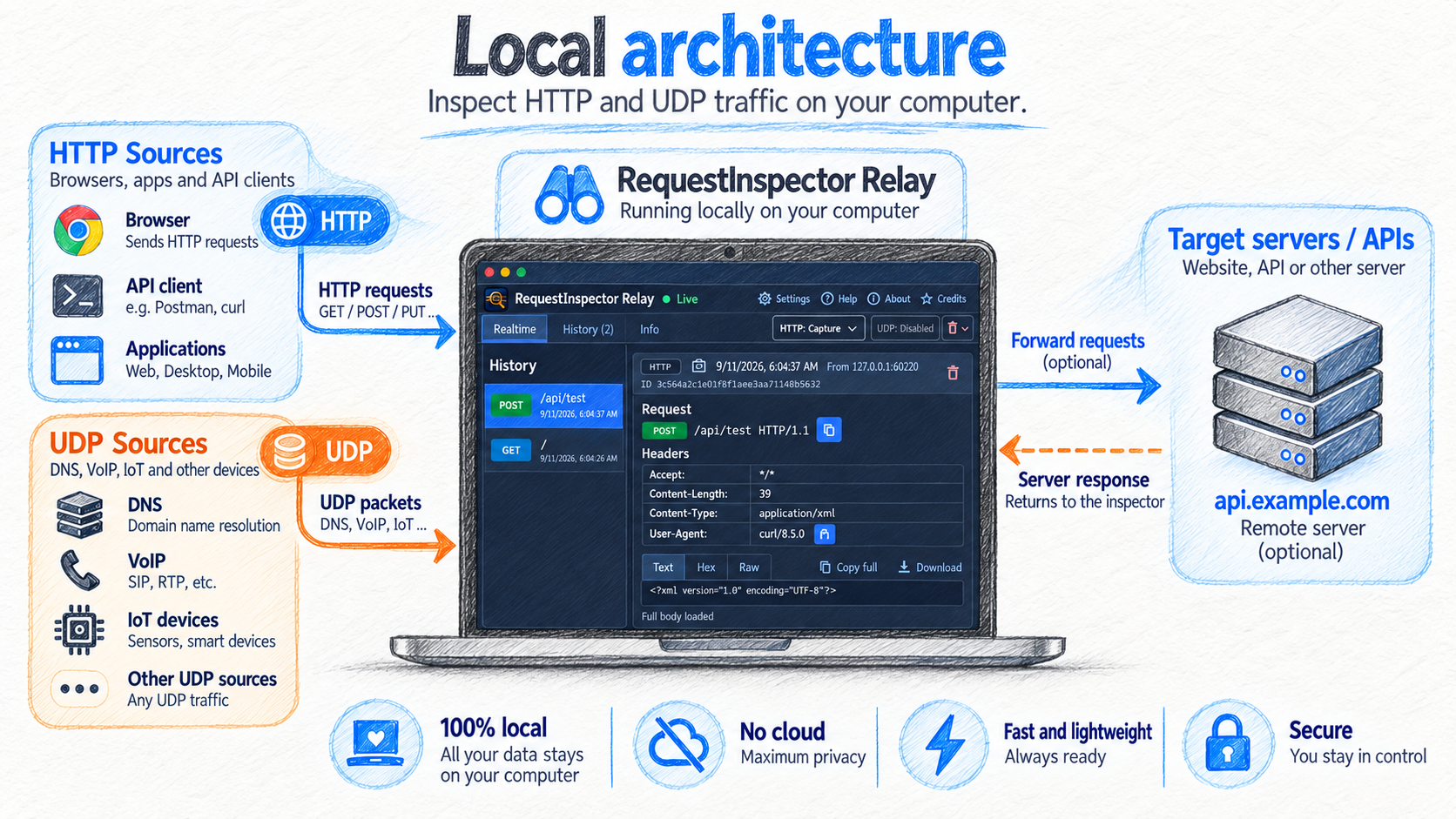
RequestInspector Relay is a local, self-hosted request inspector and reverse proxy for HTTP/1.1 and UDP traffic.
It runs as a single CGO-free binary with an embedded web interface. Capture requests, inspect live traffic, forward calls to a controlled upstream, and keep a restart-safe history without adding an external proxy or database service.
Built for local debugging
- HTTP management interface on port 8080
- HTTP traffic listener on port 8081
- UDP disabled by default
- SQLite persistence optional at runtime
Download RequestInspector Relay
Choose your platform. Standalone zero-dependency executable with embedded Web UI.
Linux
.tar.gzglibc & musl compatible
macOS
.tar.gzmacOS 11+ Big Sur, Monterey, Ventura, Sonoma, Sequoia
Windows
.zipWindows 10 / 11 / Server 64-bit & ARM
Two traffic modes
Inspect traffic with local synthetic response or forward to a live upstream.
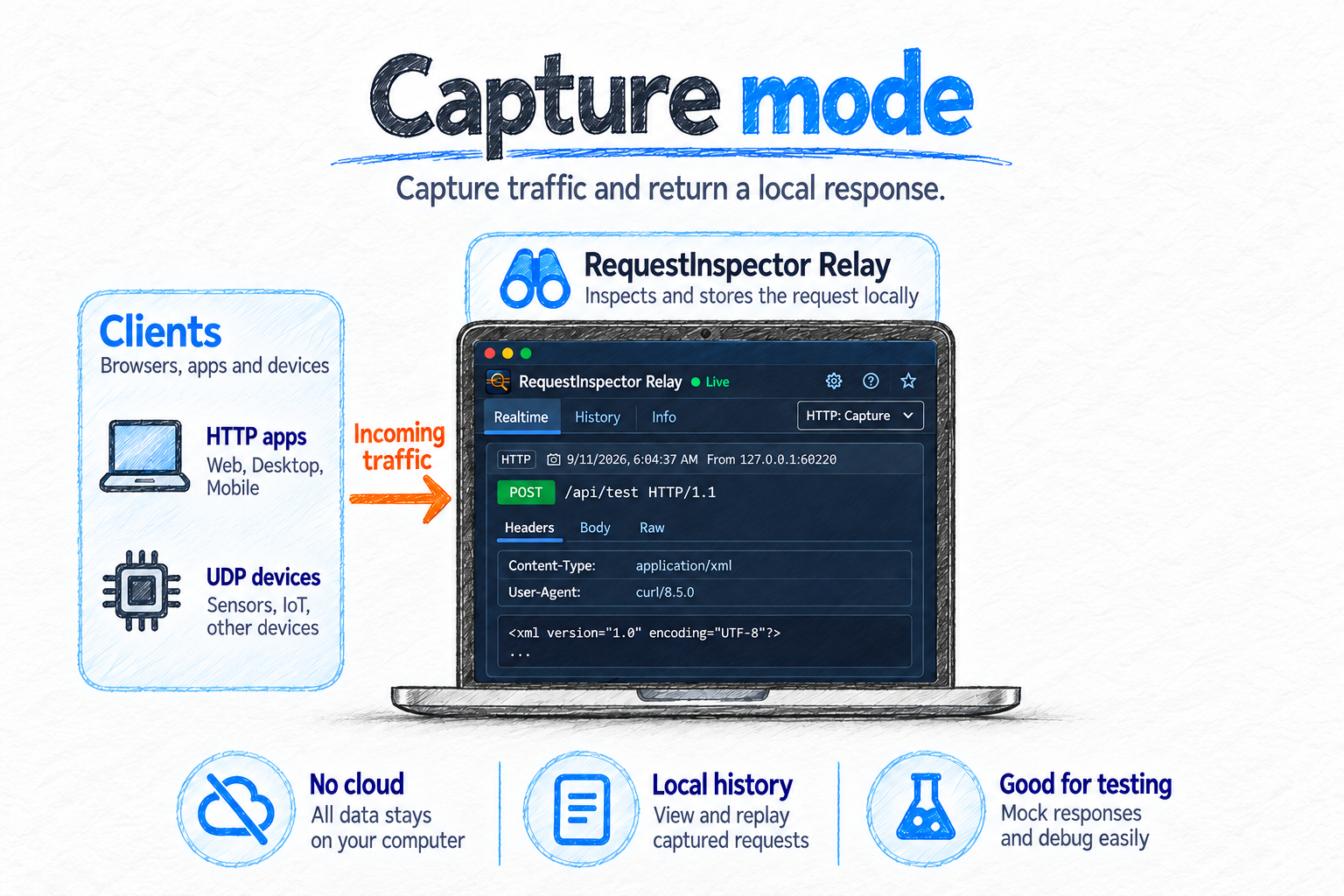
Capture mode
Record each accepted request and return a configured local response. No upstream request is created, making this mode useful for webhook development, client integration tests, mock APIs, and deterministic failure responses.
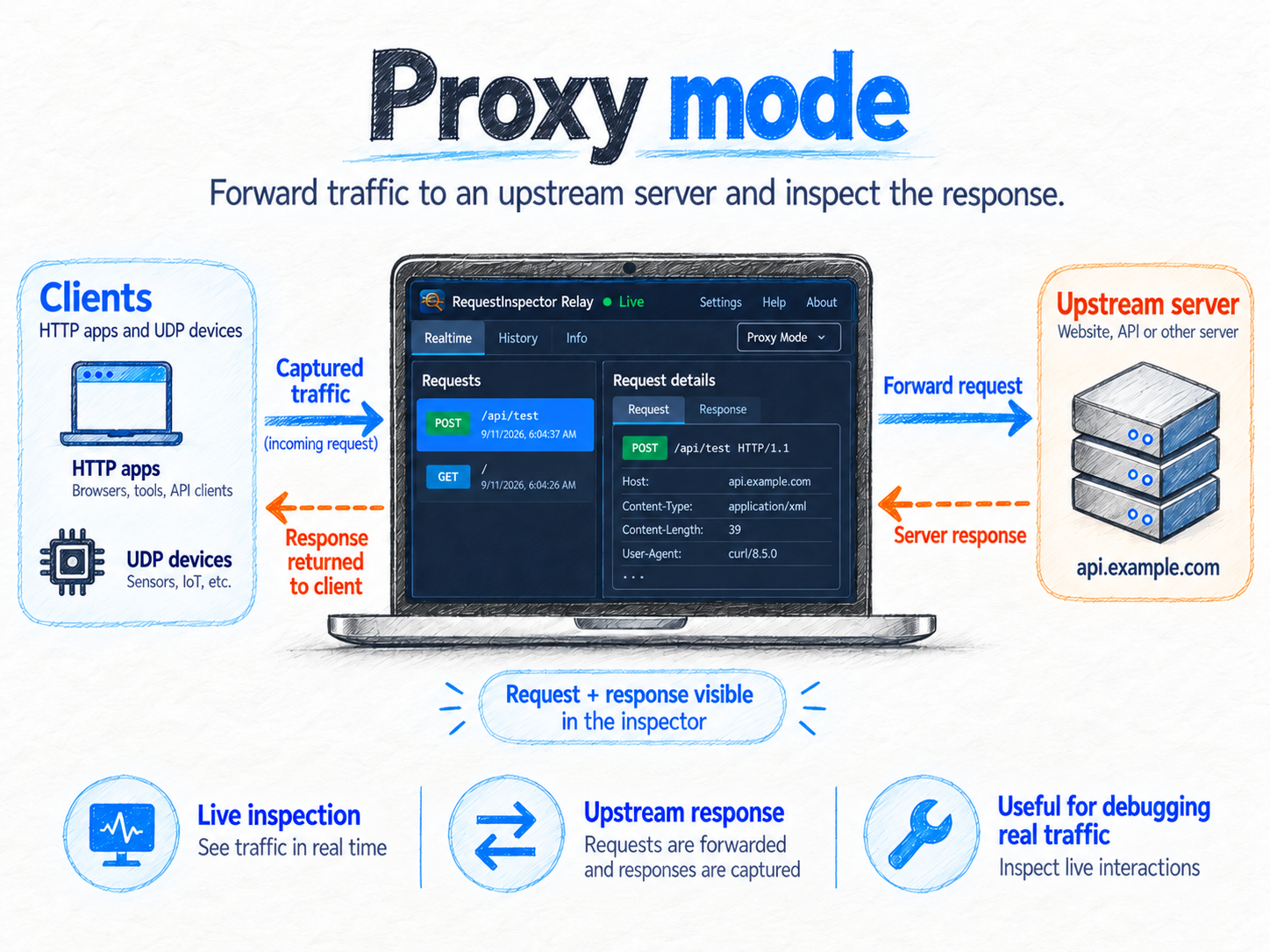
Proxy mode
Forward each accepted request to one configured HTTP or HTTPS upstream while recording the full request and bounded response. Relay preserves the method, encoded body, repeated headers, content encoding, and raw query. It exposes upstream timing, response origin, delivery errors, and bounded previews without following redirects or retrying requests.
What you can inspect
Full observability across incoming payloads, state, and pipeline execution.
Realtime and History
Realtime receives lifecycle updates over SSE and keeps the newest live exchanges visible. History combines live data with cursor-paginated SQLite summaries when persistence is enabled.
Filter HTTP and UDP traffic independently and inspect exchanges newest-first.
Requests, responses, and payloads
Review methods, paths, repeated headers, body sizes, encodings, status, timing, and delivery state. Raw bodies remain authoritative; previews, JSON, text, and hex views are bounded.
UDP exchanges show source, listener, datagram size, reply, and proxy stages.
Runtime configuration
Change capture, proxy, listener, CORS, history, authentication, and UDP settings from the interface. Runtime-safe HTTP and UDP changes hot-reload their own traffic plane; storage mode and SQLite path remain restart-required.
Safe bounded pipeline
Request and response body/header limits, concurrent exchange caps, bounded previews, SQLite writer capacity, SSE queues, and UDP session/rate limits keep resource use predictable.
Use cases
Practical scenarios where RequestInspector Relay simplifies development.
Debug webhooks and API clients
Send real requests through a local endpoint, see exactly what arrived, and compare the upstream response with the request that produced it.
Test integrations without a remote dependency
Use Capture mode to return stable status codes, headers, and bodies while exercising clients, webhooks, and error-handling paths.
Diagnose proxy behavior
Inspect URL mapping, forwarding headers, compression previews, upstream failures, response limits, and phase timings without changing application code.
Inspect UDP telemetry
Capture bounded datagrams, observe client sessions and replies, and optionally proxy to one fixed unicast upstream. UDP exposure remains an explicit operator choice.
Start with the full documentation
Review configuration, API v1, capture and proxy semantics, SQLite maintenance, and UDP security before exposing traffic beyond a trusted development network.